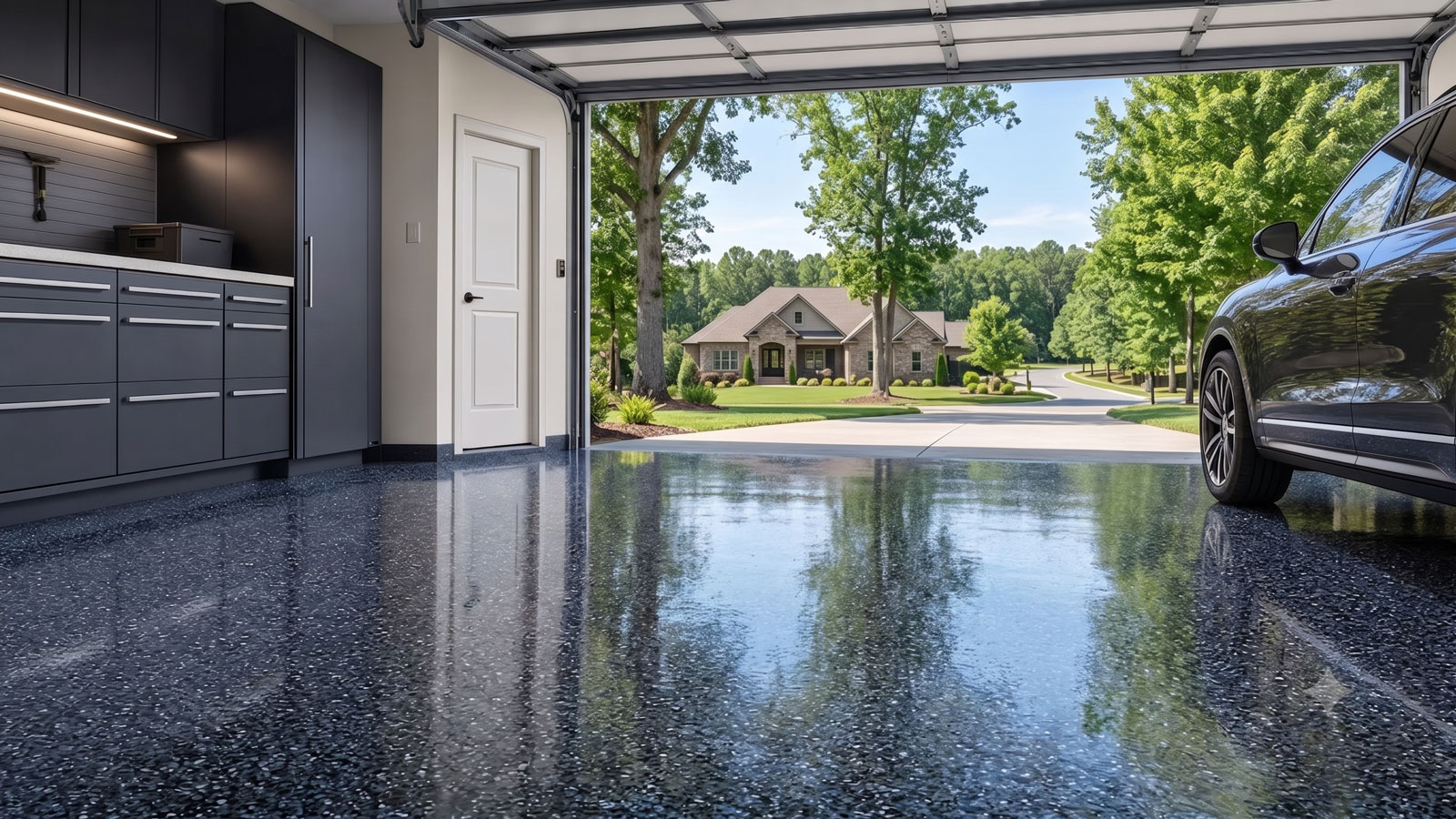
Garage Floor Coating in Millbury, MA
Floor Coating Services in Millbury, MA
Millbury includes historic residential areas—Old Common, Grass Hill, West Millbury, and East Millbury—alongside later development. That mix is a reason to inspect a garage as its own structure: a house’s age does not establish when the slab was poured, whether an addition changed it, or whether a previous finish remains. Start with concrete, joints, edges, patches, and the door threshold—not the house’s age.
Millbury’s public winter operations include road pretreatment and sand/salt spreading. Vehicles may carry slush or residue indoors, but municipal operations cannot identify what reached a particular driveway or garage. Before selecting a finish, observe whether the floor gets wet after parking, whether water appears at the door during rain or thaw, and whether tires track in grit. Those observations guide cleaning, repair, texture, and scheduling questions.
Millbury uses eight sand/salt spreaders for public-road pretreatment and deicing, while town crews maintain public water infrastructure. Neither fact identifies what reached a private garage. Ask a provider to separate observed surface preparation from any unrelated drainage concern and confirm vehicle access and cure timing.
Local Market Insight
Millbury’s eight municipal spreaders and greater-than-three-inch contractor-support criterion describe town winter operations, not clearance of a private driveway. Historic districts and later housing also do not date the concrete. Check the actual garage history, visible floor conditions, and approach before planning preparation or vehicle return.
What Affects the Cost of Garage Floor Coating in Millbury?
Millbury’s 2019 housing figures describe older and later home eras, while its winter road operations use eight sand/salt spreaders and municipal crews monitor named waterbodies and maintain public drainage assets. These separate town activities do not date or diagnose a garage. Estimate from the measured slab, its finishes, repairs, edges, and observed moisture.
Millbury’s plowable-snow criterion is greater than three inches for contractor support, not a guarantee of driveway clearance. Plan vehicle relocation and ask about site access and cure timing. Separate any observed water entry from townwide pond or drainage work.
- Historic areas and garage chronology: Old Common, Grass Hill, West Millbury, and East Millbury are named historic residential areas. Their history does not date a garage; identify later additions, repours, paint, and repairs on the actual slab.
- Dated housing-type and tenure mix: Housing figures for 2019 include around 5,600 units and about 63% detached single-family; 2007 owner/renter counts show different housing eras. These dated measures are context, not garage inventory.
- Existing coating and repair history: Paint, sealer, cracks, patches, and joints need floor-level review. Historic or mid-century house age cannot set preparation; define removal, repair, and surface profiling from the material found.
- Eight-spreader municipal program: Millbury uses eight sand/salt spreaders for road deicing and pretreatment. This town operation does not prove residue at one home; scope any added cleaning from material actually seen on the floor.
- Public water management versus property: Public crews monitor Ramshorn, Dorothy, and Brierly ponds and Singletary Lake and maintain drains. This does not diagnose garage moisture; assess any observed threshold water separately.
- Snow threshold and vehicle timing: Millbury’s contractor-support measure treats snow greater than three inches as plowable. It is not a private-driveway clearance guarantee; confirm actual access and return-to-parking timing.
Call for a clear, project-specific estimate — or request one online.
Millbury Garage History: Questions Before a Finish
Millbury’s historic residential areas and later development create varied house histories, but they do not classify garages. A garage can be original, added later, rebuilt, enlarged, or repoured. One floor may be bare concrete; another can retain paint, a prior coating, or past repairs. Building era is background, not a preparation specification.
Start at floor level. Check for peeling material, shiny sealer, patches, scaling, cracks, joint edges, and changes in level at walls or the door. Share known finish history. A prospective installer can explain whether removal, profiling, localized repair, or another finish approach is recommended and why each step is in the scope.
A garage near Old Common or in later Millbury development does not need a presumed defect because its setting is historic, or presumed easy preparation because it looks newer. Request an explanation of included and excluded work and keep it with the proposal. Decide from actual concrete condition, not a townwide history.
Winter Use, Thresholds, and Careful Scheduling
Millbury’s winter road operations include pretreatment and sand/salt spreading, so it is sensible to notice what vehicles bring home after storms. That operation does not prove salt exposure at any one garage. Slush, grit, and residue differ by route, storm, parking pattern, and use. Removing loose material and cleaning after wet parking creates a better baseline for a coating discussion.
Separate vehicle moisture from water that arrives at the threshold. Observe the floor after a snow-covered vehicle leaves, then during rain or thaw when the garage is empty. Note where water begins, how long it remains, and whether it crosses the door line. Millbury maintains public drainage and monitors local water bodies, but those activities do not determine why a particular garage is wet.
Scheduling should reflect the garage’s actual role as parking and storage. Remove stored items, identify temporary vehicle parking, and obtain the stated timing for foot traffic, light placement, and vehicle return. If weather changes the plan, get an updated timeline rather than guessing. A coating can support a cleanable surface, but it does not eliminate winter cleanup or solve active water entry.
Frequently Asked Questions
Do Millbury’s historic districts mean a garage slab is old?
No. Old Common, Grass Hill, West Millbury, and East Millbury are historic-area context; a garage can be a later addition or repour. Inspect its own finish history, patches, joints, and concrete.
Does Millbury’s eight-spreader program prove my garage has salt residue?
No. Millbury uses eight spreaders for public-road deicing and pretreatment, but that does not prove material reached a particular driveway. Note visible residue and discuss floor-specific cleaning.
Do Millbury’s pond and drainage operations show a moisture problem?
No. Millbury maintains public drainage infrastructure near several named waters, but that cannot diagnose a private garage. Record where water appears and evaluate recurring entry separately.
What does Millbury’s greater-than-three-inch snow criterion mean for my driveway?
This threshold is a contractor-support criterion for plowable snow, not a guaranteed arrival time or private-driveway clearance. Confirm actual access and vehicle arrangements for the project.
Do Millbury’s housing-era figures establish my garage’s condition?
No. Different-year housing counts describe townwide homes and household types, not an individual slab. Check the garage’s own age, prior coating, repairs, and readiness for a new system.
Millbury Neighborhoods & Local Context
Phone Quote Line
Speak with a floor coating specialist about your project and get a realistic estimate range.
(508) 691-7773Typical Project Cost
$3,000–$5,500
Typical planning range for a two-car garage. Final pricing depends on floor size, concrete condition, prep work, coating type, and finish options.
Helpful Guides
Other Service Areas