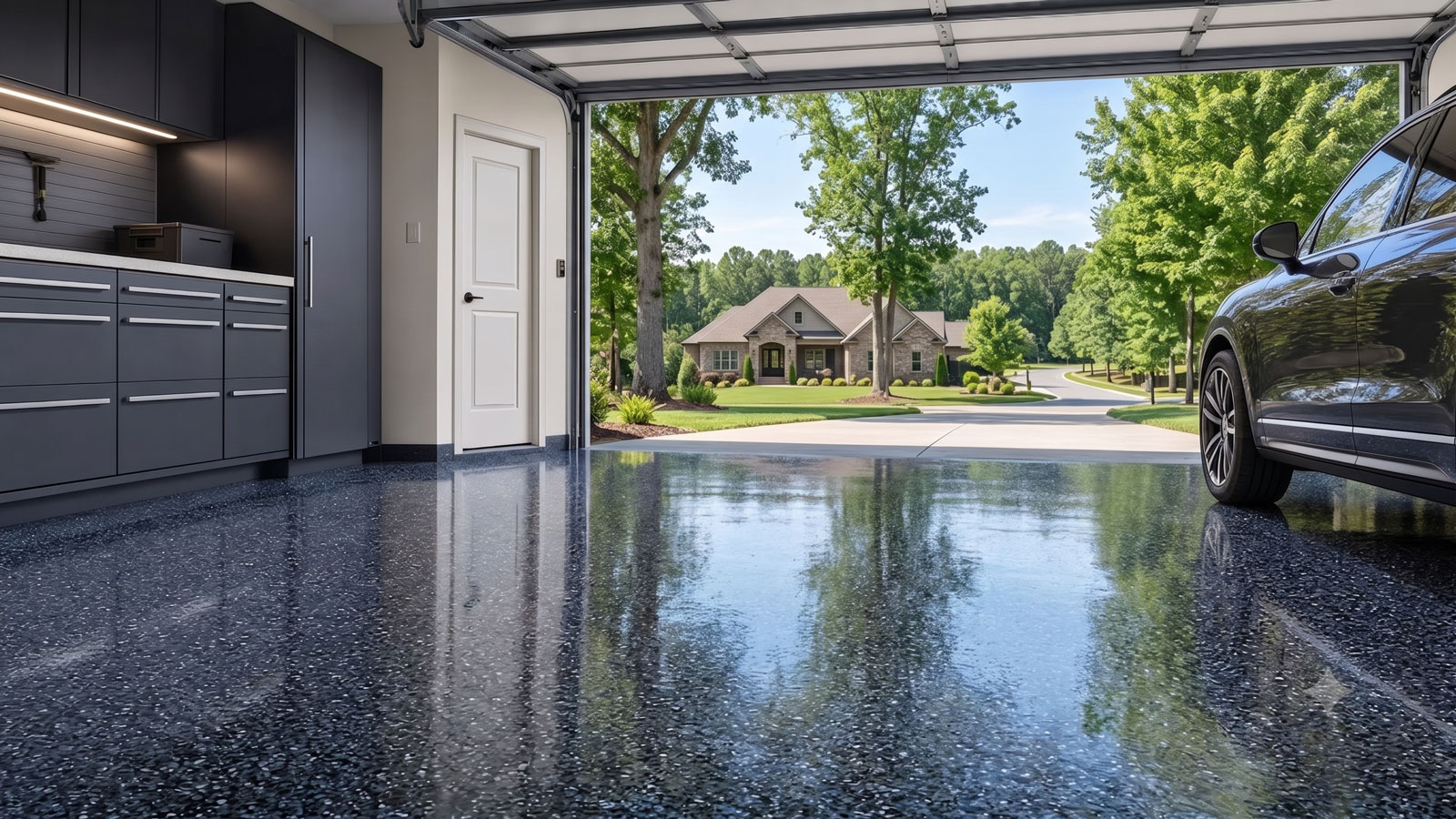
Garage Floor Coating in Shrewsbury, MA
Floor Coating Services in Shrewsbury, MA
The median construction year for Shrewsbury housing units is 1979; homes built in 1970–99 form the largest era group, and roughly three-quarters are single-family. These townwide measures do not date a garage slab, but they show why the actual garage history—addition, repour, old paint, or repairs—matters more than the house year. Inspect the concrete itself before choosing preparation. The garage’s own construction history still needs direct inspection.
The town’s landscape includes Lake Quinsigamond, Flint Pond, and mapped wetlands; none establishes moisture at a particular garage. Observe a specific threshold during rain or thaw and distinguish water carried in on a vehicle from water crossing the door. That property-level observation, not a watershed label, determines whether a separate drainage question needs attention.
Shrewsbury streets and municipal lots are swept at least twice yearly, in spring and fall. Spring sweeping in 2019 removed 472.66 tons of debris from public areas—a maintenance measure, not proof of grit in one garage. Look at the actual floor after winter parking and scope cleaning from observed conditions.
Local Market Insight
Shrewsbury combines a large 1970–99 housing-era group with a twice-yearly municipal street-sweeping cycle. Neither dates a garage or proves grit reached it. Check the slab’s own history and the material actually present after winter parking; townwide figures remain context only.
What Affects the Cost of Garage Floor Coating in Shrewsbury?
Shrewsbury’s 1979 median housing year and 1970–99 building plurality are context, not a concrete specification. A garage may be newer than its home or carry old paint, a repour, or repairs. Estimate from the observed surface, layout, edges, and work required for the selected system.
Public streets and lots are swept twice a year, including spring cleanup after winter. The 472.66 tons collected in spring 2019 was a municipal street-maintenance measure, not evidence about one garage. Describe visible grit and any water at the threshold; compare proposals on actual preparation and access.
- 1979 median housing year—not slab age: Shrewsbury’s median housing-unit construction year is 1979. Confirm whether the individual garage is original, later-added, repoured, or previously finished before estimating preparation.
- Residential form and access: Roughly three-quarters of Shrewsbury homes are described as single-family and owner-occupied. That does not prove garage availability; measure the actual bay, shared access, edges, and storage.
- Paint, sealer, and prior repairs: Housing-era variation can coexist with later garage work. Identify old coatings, patches, cracks, and joints on the floor itself; estimate removal and repair rather than infer them from the home’s age.
- Post-winter cleaning questions: Shrewsbury’s municipal streets are swept each spring, but its street debris totals do not reveal a home’s garage condition. Scope cleaning from observed tire-borne grit, slush, or residue, not from a town statistic.
- Threshold and watershed context: Lake and wetland maps do not diagnose a garage. If water appears at a threshold, document when and where; a separate drainage evaluation may be needed before coating work is scoped.
- Clearing space and cure plan: Steps, curbs, drains, belongings, and vehicle needs affect access. Confirm clearing and return-to-use timing, especially if routine parking would conflict with the provider’s preparation or cure period.
Call for a clear, project-specific estimate — or request one online.
Observe Water at the Shrewsbury Garage Threshold Before Drawing Conclusions
Wetlands and watershed boundaries are landscape context, not a garage diagnosis. A homeowner anywhere in Shrewsbury should not treat a map as proof that a slab is damp or that a coating will stop water entry. The useful evidence is water’s actual route at the property: across the driveway, along the foundation, toward the opening, or simply in on vehicle tires.
During ordinary rain and after snowmelt, look for water collecting outside the door, crossing the threshold, or leaving a repeatable indoor pattern. Note whether wetness follows parking, affects one edge, or appears tied to a downspout or driveway slope. Safely taken photos can help describe conditions in a referral conversation without diagnosing their cause.
These observations guide different decisions. Tire-borne meltwater and residue bring cleaning, preparation, and traction into focus. Repeated threshold entry may warrant separate drainage or building-envelope evaluation before a finish is selected. A coating is a floor-surface option, not a flood, drainage, or moisture cure, and the sequence gives a provider clearer information to evaluate.
Mixed Housing Eras Call for a Garage-Specific Preparation Plan
Shrewsbury’s mixed housing eras, including its large 1970–99 residential-building group and 1979 median construction year, can guide questions but cannot date a garage slab. A garage may be an addition, a repour, an expansion, or a floor that has been refinished. House age is not a concrete specification.
Start with what can be seen: prior paint, clear sealer, coating edges, patched cracks, worn paths, spalling, and changes in texture or color. Identify control joints, drains, steps, curbs, and perimeter details. A referred provider can distinguish preparation, repair, and unknowns that require inspection instead of promising one product suits every garage.
Preparation should reflect use. A winter vehicle space may need a practical cleanup routine and texture discussion for wet footwear; a workshop may make edge details and staged access more important. Ask about surface preparation, repair boundaries, existing-finish compatibility, and return-to-use instructions. Worcester Epoxy can organize questions and referrals; it does not install or guarantee outcomes.
Frequently Asked Questions
What does Shrewsbury’s 1979 median construction year say about my slab?
It describes town housing units, not garage concrete. The garage may have been added or repoured later. Inspect the actual finish, patches, joints, edges, and floor condition before choosing a coating scope.
Does Shrewsbury’s single-family housing share mean every home has a garage?
No. The town’s housing-type mix is not a count of garages. Verify the specific space, including whether it is attached, detached, shared, or used for storage, and plan access around those facts.
Does Shrewsbury’s spring street-sweeping total show my garage has grit?
No. The 472.66 tons collected in spring 2019 is a municipal street-maintenance measure. It does not establish garage contamination. Look at the actual floor and describe visible residue.
Do Lake Quinsigamond or Flint Pond watersheds imply water in a garage?
No. Watershed and wetland mapping provides landscape context only. Observe whether rain or thaw actually crosses the threshold; do not use a map or a coating as a diagnosis or fix for water entry.
What winter-cleanup question is specific to a Shrewsbury project?
The town schedules spring post-winter sweeping of public streets and lots, but private-garage conditions vary. Ask how the provider wants visible grit or slush cleaned before preparation and what care the chosen floor system needs afterward.
Shrewsbury Neighborhoods & Local Context
Phone Quote Line
Speak with a floor coating specialist about your project and get a realistic estimate range.
(508) 691-7773Typical Project Cost
$3,000–$5,500
Typical planning range for a two-car garage. Final pricing depends on floor size, concrete condition, prep work, coating type, and finish options.
Helpful Guides
Other Service Areas